
Shellac records belong upright on a shelf, in acid-free paper sleeves and in a cool, dry place. Follow these three rules and you protect your collection from breakage, warping and mould.
Many shellac records have survived for decades – often not because of how they were stored, but in spite of it. They sat in boxes in damp basements, in tall stacks in the attic or in a cupboard right next to the radiator. If you inherit, buy or build a collection today, you can do better.
This matters, because damage from poor storage can hardly be undone. A broken record stays broken, and a warped one is difficult or impossible to play. This guide shows you how to store your 78s properly – from the shelf and the sleeve to moving house.
Why Shellac Needs Special Care
Shellac records are made of a natural resin mixed with mineral powder and soot. This gives them properties that matter for storage:
| Property | What it means | What it means for storage |
|---|---|---|
| Brittle | breaks under pressure or impact instead of giving way | don't stack, don't squeeze, pad well for transport |
| Heavy | a 10-inch (25 cm) record weighs about 170–230 g | sturdy shelves, small boxes |
| Sensitive to heat | the material softens when warm and can warp | no radiators, no sunlight, no attic |
| Sensitive to moisture | paper sleeves, labels and dirt feed mould | keep dry, watch the humidity |
The Most Important Rule: Upright, Not Stacked
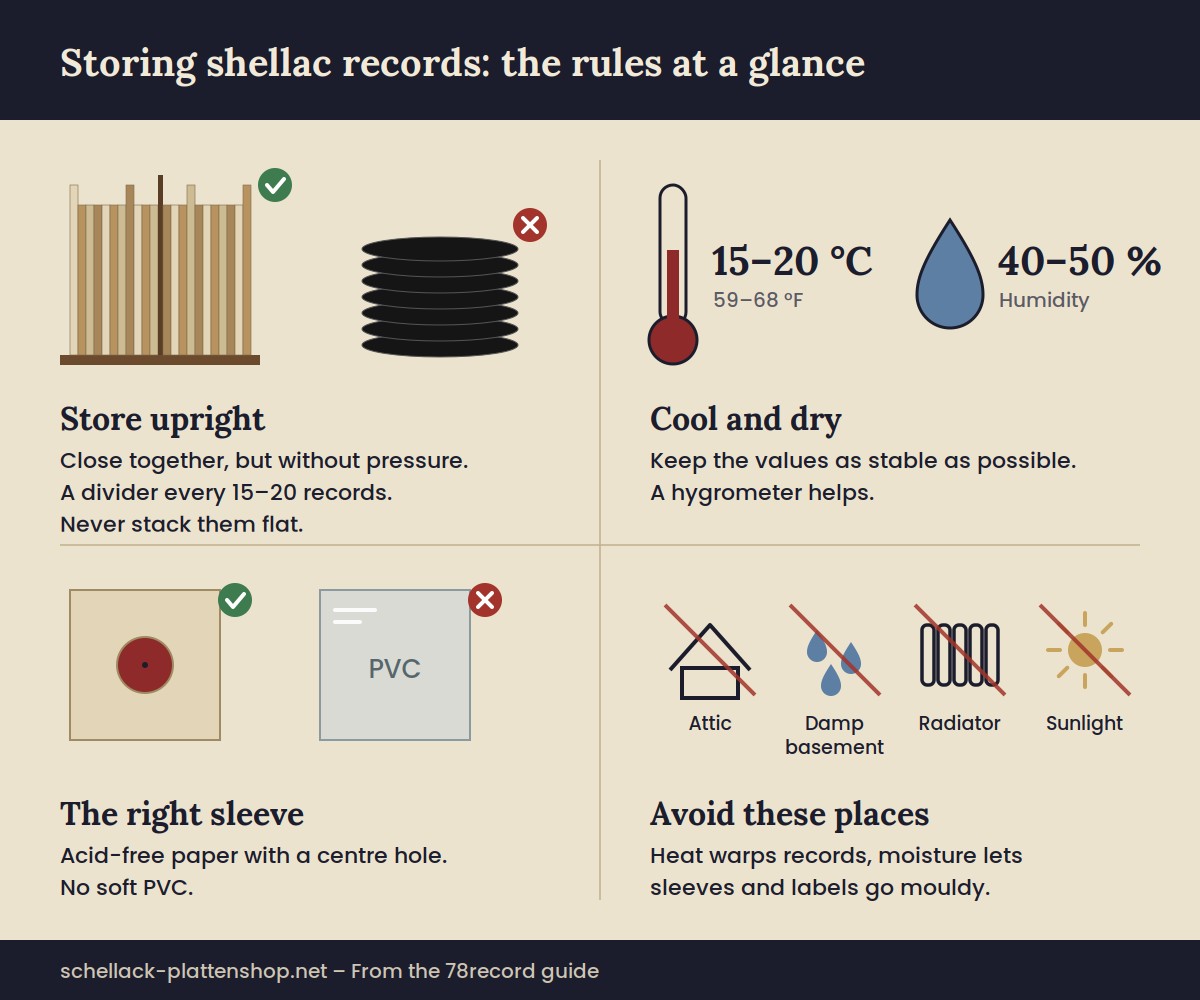
Shellac records are stored vertically, like books on a shelf. They should stand close together, but without pressure. That way the weight is spread evenly along the edge, and no record carries the load of the others.
- Don't let them lean: Records that stand at an angle for months can warp. If a shelf is only half full, use bookends or a record rack.
- Use dividers: In large collections, solid dividers every 15 to 20 records stop pressure from building up along the whole row.
- Keep sizes apart: Ideally, store 10-inch and 12-inch (25 and 30 cm) records in separate compartments. A large record between small ones is put under uneven pressure.
- Don't stack them flat: In a stack, the bottom record carries the weight of all the others. Even a tiny crumb between two records can then cause a crack.
The Right Sleeve
A good inner sleeve protects against dust, scratches and direct contact with the neighbouring record. Not every sleeve is suitable.
- Acid-free paper: Acid-free paper sleeves with a centre hole are ideal. The hole shows the label, so you can identify the record without pulling it out.
- No soft PVC: Sleeves made of soft plastic can release plasticisers and stick to the surface over time. They are not suitable for shellac.
- Original company sleeves: Old paper sleeves from the record labels are often collectibles in their own right, but they are frequently acidic and brittle. If the record also sits in a neutral inner sleeve, both record and sleeve stay protected.
- Record albums: Historic record albums are well suited for storage. Full albums are heavy, though, and also belong upright on the shelf.
You can find matching sleeves in 10 and 12 inches in our record sleeves category.
The Right Climate: Cool, Dry and Stable
The ideal is about 15 to 20 °C (59 to 68 °F) with 40 to 50 percent humidity. Even more important than the exact values is that they stay stable. Big swings between summer and winter, or day and night, put strain on records, labels and sleeves. A simple hygrometer costs only a few euros and quickly shows whether a room is suitable.
| Storage location | Suitable? | Why |
|---|---|---|
| Living space, on an interior wall | Yes | stable temperature, normal humidity |
| Dry, heated basement | With care | possible if the hygrometer stays below 55 percent at all times |
| Damp basement | No | mould on sleeves and labels |
| Attic | No | heat in summer, cold in winter |
| Next to a radiator, stove or window | No | heat and sunlight can warp records and fade labels |
| Garage, garden shed | No | strong swings in temperature and humidity |
Tip: Don't place shelves directly against a cold exterior wall. Moisture can build up behind the shelf there. A few centimetres of space is usually enough.
Shelves, Boxes and Record Racks
Shellac is heavy. A fully loaded metre of shelf with 10-inch records can easily weigh 40 to 50 kilograms (about 90 to 110 lb). Many bookcases aren't built for that – the shelves sag over time, and the records no longer stand straight.
- Solid shelves with a short span: The shorter the distance between supports, the less the shelf will sag.
- Secure the shelf to the wall: A heavy, tall shelving unit should always be fixed to the wall.
- Heavy at the bottom, light at the top: Put 12-inch records and full albums on the lower shelves, smaller batches higher up.
- Boxes only as a temporary solution: Sturdy wooden or archive boxes work in the meantime. The records stand upright inside, and the boxes aren't stacked high on top of each other.
Moving and Transport: Packing Records Safely
More shellac records break during a move than in decades on the shelf. A little care is enough to prevent that.
- Check the sleeves: Every record is in its sleeve. Loose records must never touch each other directly.
- Choose small boxes: Several small, sturdy boxes are better than one large crate. A box with 25 records already weighs about 5 to 6 kilograms.
- Pack upright and tight: The records stand vertically and close together so they can't shift.
- Fill the gaps: Fill any space at the top and sides with bubble wrap or crumpled paper. Nothing should rattle in the box.
- Label clearly: Write "Fragile – shellac records – keep upright" on several sides.
- Avoid heat: Don't leave boxes in a hot car or in the sun.
- Unpack right away: Put the records back on the shelf soon after arriving, so they don't sit in boxes for weeks.
Common Storage Mistakes
| Mistake | Result |
|---|---|
| Records lying flat in tall stacks | cracks and breaks in the bottom records |
| Records leaning at an angle | warping, the stylus jumps or the sound wavers |
| Soft PVC sleeves | plasticisers can attack the surface |
| Records without inner sleeves | scratches, dust in the grooves, more surface noise |
| Storage in the attic | heat warps the records |
| Storage in a damp basement | mould on sleeves and labels |
| Overloaded, flimsy shelf | sagging shelves, uneven pressure |
Lacquer discs, also called instantaneous recordings, need special attention. These privately recorded discs have a thin lacquer coating on metal, glass or cardboard and are even more fragile than shellac. Store them upright as well, especially cool and separate from your other records, and if the coating is flaking, it's best not to handle them yourself.
Checklist: Storing Shellac Records Properly
- Store records upright, close together but without pressure
- Dividers every 15 to 20 records, 10-inch and 12-inch kept apart
- Acid-free paper sleeves with a centre hole, no soft PVC
- 15 to 20 °C (59 to 68 °F), 40 to 50 percent humidity, as stable as possible
- No attic, no damp basement, no radiator, no sunlight
- Sturdy shelves with a short span, secured to the wall
- Only touch records by the edge and the label
Conclusion
Storing shellac records properly is easier than it sounds. Upright, well protected and in a cool, dry place, they will last for many more decades. If you also use sturdy shelves and acid-free sleeves, you've already taken care of the most important things. And before a dusty new find goes onto the shelf, take a look at our guide How to Clean Shellac Records Properly.