
A steel needle plays exactly one record side – then it's done. Whether you choose soft, medium or loud depends above all on its thickness: the thicker the needle, the louder the gramophone.
A gramophone has no amplifier and no volume knob. The needle follows the groove, passes every vibration on to the diaphragm in the soundbox, and the horn turns it into music. That makes the tiny needle the only part that actually touches the record – and an important part of the sound. This guide shows which needle suits which occasion, what thorn needles do differently and why you should never economise on steel needles.
Soft, Medium or Loud: Thickness Shapes the Sound
Steel needles differ mainly in their diameter. A thick needle is stiff and passes the vibrations of the groove almost entirely to the diaphragm. A thin needle flexes slightly, absorbs some of the energy and therefore sounds quieter and softer. So by choosing the needle, you set the volume of your gramophone.
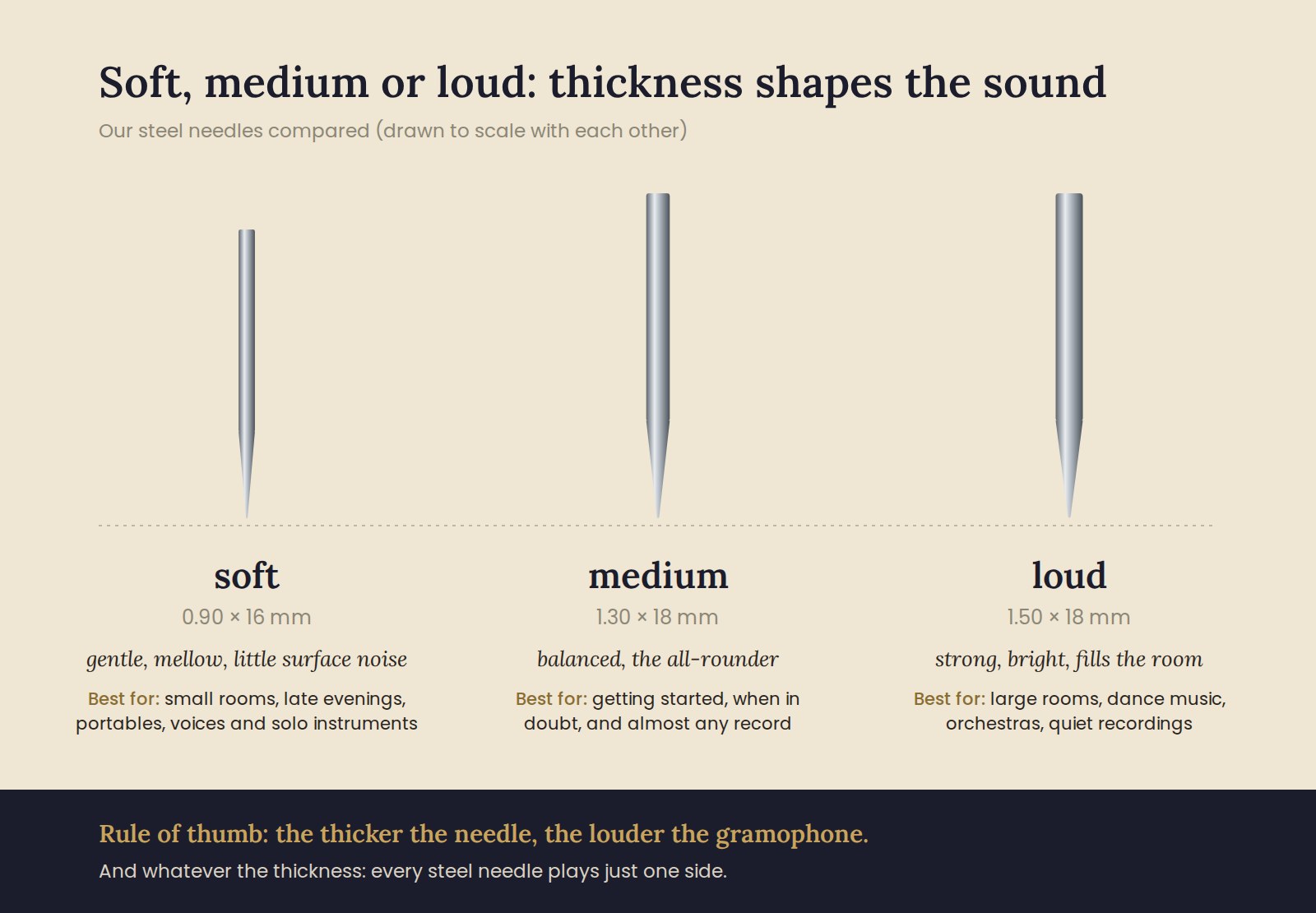
| Needle | Size | Sound | Best for |
|---|---|---|---|
| soft | 0.90 × 16 mm | gentle, mellow, little surface noise | small rooms, late evenings, portables, singing and solo instruments, well-played records with a lot of surface noise |
| medium loud | 1.30 × 18 mm | balanced | everyday listening and almost any record – the right choice when in doubt |
| loud | 1.50 × 18 mm | strong, bright, fills the room | large rooms, dance music and parties, orchestras, quietly recorded discs |
A few lessons from practice:
- Portable gramophones are often surprisingly loud at close range. In a living room, a soft or medium needle is usually enough.
- Large horn and cabinet gramophones fill a room even with a medium needle. The loud needle is mainly worth it for parties, dance evenings or large rooms.
- Heavily played records often sound more pleasant with a soft needle, because the surface noise gets quieter too.
- Early acoustic recordings from before about 1925 were often cut more quietly. A step louder works well here.
Tip: If you don't know your gramophone well yet, start with the medium needle and then try one step up or down. In the end, your ears decide.
Steel or Thorn?
Alongside steel needles, needles made from plant material appeared early on: thorn needles made from hard plant thorns, and fibre needles made from bamboo. They are softer than shellac. Instead of the record grinding down the needle, it is mainly the needle itself that wears – which spares the groove.
| Steel needle | Thorn or fibre needle | |
|---|---|---|
| Sound | clear, strong, soft to loud depending on thickness | gentle, warm, noticeably quieter |
| Surface noise | audible depending on the record | usually lower |
| Kindness to the record | good, as long as each needle plays only once | very gentle |
| Lifespan | exactly one record side | can be resharpened with a sharpener, but sometimes loses its point during a side |
| Handling | simple, fits any standard soundbox | more effort, fibre needles sometimes need their own holder |
| Availability | good | more of a speciality today |
For everyday listening, the steel needle is the practical choice: it's reliable, inexpensive and sounds the way the record companies intended back then. Thorn needles are an option for collectors who want to play especially rare or delicate records as gently as possible and are happy to accept a quieter sound and more handwork in return. One important point with thorn needles: if the sound audibly fades or starts to scratch, stop the record at once and resharpen the needle.
Why a Steel Needle Plays Only Once
Shellac records aren't made of shellac alone, but also of fine mineral powder. These fillers make the record hard and durable – and they act on the needle like fine sandpaper. That isn't a design flaw, it's intentional: during one record side, the groove gradually grinds the steel tip to match its own shape.
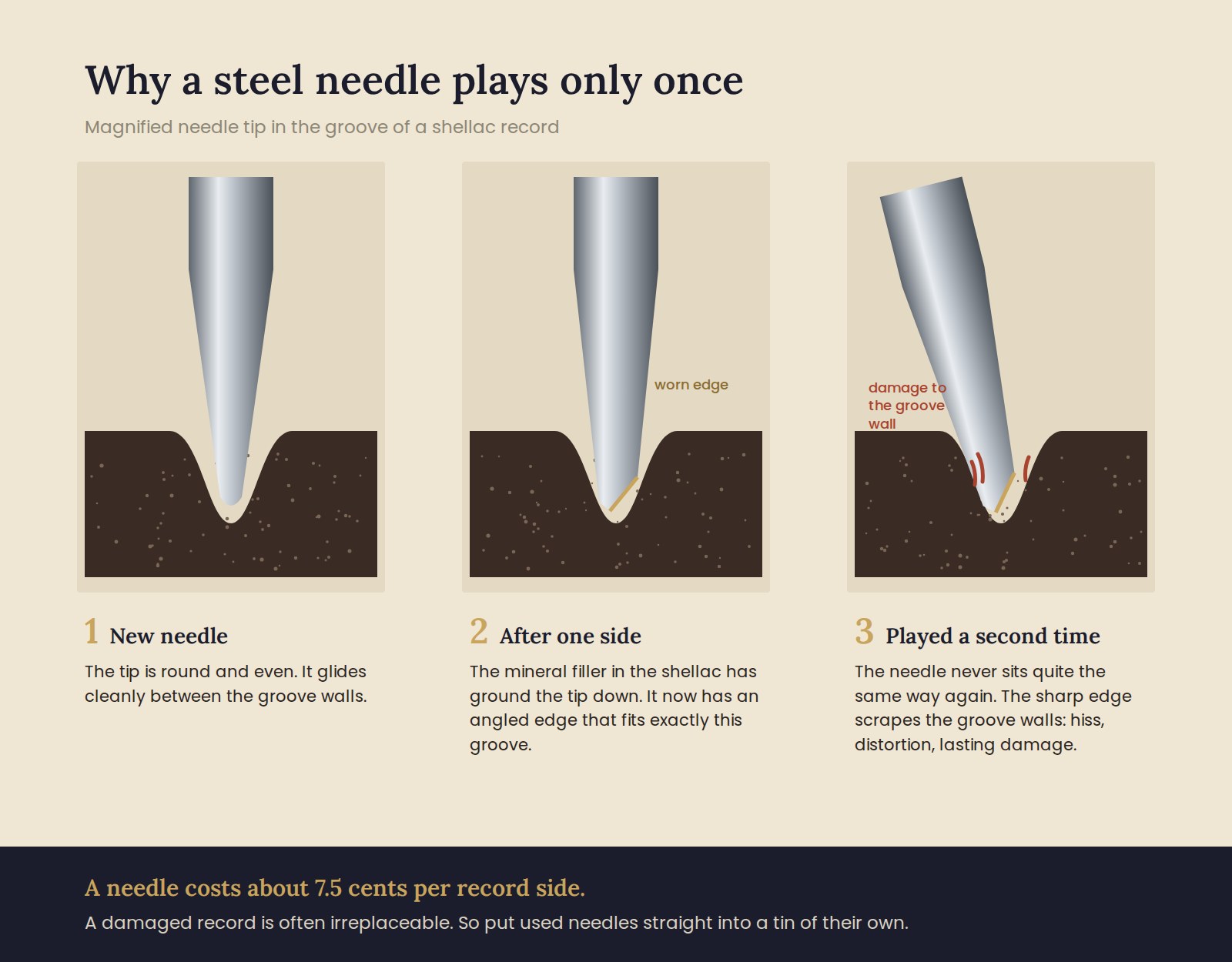
After one side, the needle therefore has an angled, worn edge that fitted exactly that one play. If you use the needle a second time, it never sits in the holder and the groove in exactly the same way again. The sharp edge then scrapes the groove walls. You hear the consequences right away: more hiss, distorted notes, and in the worst case the needle skips. What you don't hear is the lasting damage to the groove – every future play of that record will sound worse.
It's no coincidence that many historic needle tins carried a reminder to use a new needle for every record side. The maths is simple: with 100 needles for €7.49, one record side costs about 7.5 cents. A damaged record, on the other hand, is often irreplaceable.
Changing the Needle Properly
- Stop the gramophone: Stop the turntable and place the tone arm with the soundbox safely in its rest, or lift it up.
- Loosen the screw: Turn the small set screw on the needle holder of the soundbox out a little. It doesn't need to come out completely.
- Remove the old needle: Pull out the used needle and put it straight into the tin for used needles – never back with the new ones.
- Insert the new needle: Push the new needle straight into the holder so that it sits firmly without any play.
- Tighten the screw: Firmly, but with feeling. A wobbly needle sounds distorted and harms the groove; an overtightened screw harms the thread.
- Lower it gently: Carefully set the soundbox down in the lead-in groove at the edge of the record.
Tip: Change the needle right after playing, not just before the next record. That way there's never a used needle in the soundbox that might accidentally be played again.
Storing Needles Properly: Needle Tins
Steel needles like it dry. Moisture makes them rust, and a rusty tip is rough – it no longer belongs on a record. Loose needles in a drawer also get mixed up quickly: new with used, soft with loud. On top of that, used needles are sharp and shouldn't be left lying around.
- Use two tins: one for new and one for used needles. Many gramophones also have a small compartment or cup for this.
- Sort by thickness: Keep soft, medium and loud needles separate and label the tins.
- Store them dry: The tins belong in the same dry place as your records, not in a damp basement.
- Dispose of used needles safely: in a tightly closed container so that nobody gets pricked.
Historic metal needle tins aren't just practical, by the way – with their colourful designs, they're a lovely collecting field in their own right. You'll find a selection in our needle tins category, and matching needles in all three strengths under needles.
Important: Steel Needles for Shellac Only
Steel gramophone needles are made for shellac records. On softer material they cause serious damage. So never play vinyl 78s, LPs or singles on a gramophone, and never fit steel needles to a modern record player. If you're unsure whether a record is shellac or vinyl, check its weight, sound and label before you play it.
Common Mistakes
| Mistake | Result |
|---|---|
| Using a needle a second time | hiss, distortion, lasting damage to the groove |
| New and used needles in the same tin | used needles accidentally end up on a record again |
| Needle sits loosely | distorted sound, the needle can skip |
| Using rusty needles | the rough tip scratches the groove |
| Loud needle in a small room | shrill and tiring – choose a softer one |
| Steel needle on vinyl | the record gets damaged |
Checklist: Choosing the Right Gramophone Needle
- Soft for small rooms and well-played records, medium as the all-rounder, loud for large rooms
- When in doubt, start with medium and adjust by ear
- A new steel needle for every record side
- Insert the needle straight and tighten firmly, but with feeling
- New and used needles in separate tins, stored dry
- Thorn needles as a gentle alternative for special records
- Steel needles for shellac only, never for vinyl
Conclusion
Finding the right needle is easy: thickness sets the volume, and your room and your records set the thickness. But more important than the choice between soft and loud is one simple habit – a fresh needle for every side. It costs a few cents and protects records that are often already a hundred years old. To keep them in good shape between plays, take a look at our guides How to Store Shellac Records Properly and How to Clean Shellac Records Properly.